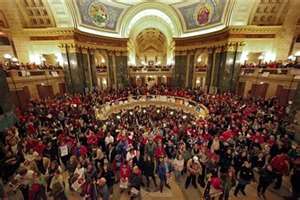
Monday, February 28, 2011

Forced Unionism

Two Sisters From The Right have been featuring articles on the problems that have recently arisen between teachers unions and state governments.  It is our opinion that the White House and those in the federal government including the Secretary of Labor have overstepped their bounds by interjecting themselves in issues that need to be solved by the individual states.

Teachers unions belong in the public domain, and not in the private sector.  Although we feel that there was a time in our history when unions were beneficial to laborers, the time has come to take a closer look at the evolution of labor unions, particularly at the influence of criminals (the mob), and political parties, particularly the Democratic party.  In researching labor unions preparing to write the introduction to today's featured article, we came across this quote:   

"All Government employees should realize that the process of collective bargaining, as usually understood, cannot be transplanted into the public service. It has its distinct and insurmountable limitations when applied to public personnel management. The very nature and purposes of Government make it impossible for administrative officials to represent fully or to bind the employer in mutual discussions with Government employee organizations. The employer is the whole people, who speak by means of laws enacted by their representatives in Congress. Accordingly, administrative officials and employees alike are governed and guided, and in many instances restricted, by laws which establish policies, procedures, or rules in personnel matters.


Particularly, I want to emphasize my conviction that militant tactics have no place in the functions of any organization of Government employees. Upon employees in the Federal service rests the obligation to serve the whole people, whose interests and welfare require orderliness and continuity in the conduct of Government activities. This obligation is paramount. Since their own services have to do with the functioning of the Government, a strike of public employees manifests nothing less than an intent on their part to prevent or obstruct the operations of Government until their demands are satisfied. Such action, looking toward the paralysis of Government by those who have sworn to support it, is unthinkable and intolerable."  Franklin D. Roosevelt,
August 16, 1937

Letter on the Resolution of Federation of Federal Employees Against Strikes in Federal Service

You'd think someone in the media would have found that quote as easily as we did.  Franklin Delano Roosevelt, a Democrat and friend of Labor is expressing in those words that what has been happening in Wisconsin the last three weeks, is, in his words, "unthinkable and intolerable."
Two Sisters


http://www.americanthinker.com/2011/02/end_forced_unionism.html

End Forced Unionism


By Bruce Walker


Where would we be without labor unions? We would be much better off.

Americans do not understand what "labor unions" mean. Nothing prevents a group of workers at a plant or office from getting together, signing an agreement which delegates power to negotiate contracts to certain representatives, and then proceeding with collective bargaining by those workers who chose to sign the agreement. That is not unionism; it is simply a business arrangement, much like when an athlete has an agent or a client has a lawyer.

The problem with unionism is that those who do not feel such an agreement is needed are compelled to surrender their right to bargain for their working conditions and compelled, as well, to support a vast, expensive bureaucracy of labor satraps. It is coercion of workers masked as industrial democracy. If 49% of the "represented" workers want a wage freeze but more vacation time, and that is not the official union position, then the union bosses are working against the interest of these workers. If many workers feel union rules reduce efficiency, and so the prospects of more jobs, those workers have to pay for the privilege of their representatives doing exactly the opposite of what these wish.

Coerced unions were always unnecessary, wasteful, and immoral -- and all unions today are coerced unions. Depending upon whether a state has a "closed shop" (only members of a union can be hired, and these must comply with union rules) or "union shop" (new employees must join the union after being hired), if a state has no right to work law, employers must negotiate with the union instead of the individual worker. Only 22 states now have right to work laws, although robust Republican state governments could add six more states to that column, five in the Great Lakes region alone.

Our Great Lakes Region was once the industrial dynamo of the world. Unions murdered its prosperity. Towns and cities in the Great Lakes that ought to be humming with activity are now dwindling into ghost towns.

People invariably can be persuaded that in free economic transactions, like the decision of people to work in a coalmine or tractor factory, the workers are getting the short end of the stick. Market economics, however, prevents "exploitation" from being more than a brief aberration and these fluctuations are as likely to unjustly enrich workers (for a short time) as to enrich employers. Only a mind focused on envy and anger can pretend that laws denying the liberty of employment somehow make life better.

It is blindingly clear to any open mind that unions, especially public employee unions, do not even pretend to make an economic argument for their position. Labor negotiations, more and more, are simply exercises in naked political power. The dues snatched involuntarily from workers who oppose being drafted into supporting collectivist Democrats are used to buy politicians. Aside from the crushing "tax" upon our nation's economy which union dues and union restrictions on liberty cost our nation, the social effect of a work environment smothered beneath big labor, big business, and big government squeezes most Americans into lonely atoms in the business of America.

These leviathans are the antithesis of what our country needs to survive and to thrive in a world of instant communication, evolving technology, and global market price systems. Few, if any, people in history have been such rugged individualists as Americans. Our ability to innovate, to adapt quickly, to push unconventional approaches to their limits -- all these have made us great, and in more than just wealth and power. Unions are the antipode of this supreme American virtue. Unions are the incarnation of the putrid body of Marx and all his bitter disciples.

Unions, including especially public employee unions, have function only in a grim universe of constant conflict and suspicion. They are close siblings of feminists who find transcendent grievance in the fact of gender. Unions find family with "civil rights" activists, whose wealth and power are dependent upon the hopelessness of black people. Unions are natural cousins of personal injury lawyers whose only commandment is "Do anything to win" or leftist politicians whose guiding principle is "Promise anything."

The America of 2011 is shackled with crippling chains -- tax rates, particularly on capital gains; environmental regulations calculated to impoverish us into "green" living; goose-stepping media who sappily salute any sin of leftism; militant atheism masking as some sort of faux-Americanism; vast and awful pyramids of public debt and fathomless seas of future entitlements -- and so much more. Do we want a bright future? Do we want our country back? Abolish forced unionism, beginning with government workers. Republicans are weak, far too weak, on this particular issue. Unions are not just the political enemy of Republicans; they are the ideological enemies of liberty. Republicans should heed the quip of President Reagan when his assistants warned that some of his policies were too extreme: "What are they going to do to me? Hang me from a higher tree?"

Governor Walker in Wisconsin is experiencing now what every Republican governor who tries any real reform of the workplace will encounter: fanatical, take-no-prisoners, hatred. Why not push for total victory and a free, productive workplace throughout the land?

Bruce Walker is the author of a new book: Poor Lenin's Almanac: Perverse Leftists Proverbs for Modern Life


 © American Thinker 2011

Labels:

On Teachers and Others

We wondered as we read this article what sort of reception it would receive from our readers.  We anticipated that they would make the comparison that teachers are college educated and invested a great deal of money receiving their credentials.  Because we attended high school and college in rural Illinois we'd like to testify that a great number of the farmers we knew were college educated as was the author while he was farming.  Many of our college classmates returned home to farm after receiving their degrees.  However, had they not, Mr. Hanson's comparisons are still just as valid.
Two Sisters


VICTOR DAVIS HANSON

In judging teachers’ claims, we might compare their lives with the lives of, say, farmers or welders or interstate truckers.


Victor Davis Hanson
So far the angry teachers of Wisconsin have not yet won over the public. They have not convinced the majority that, in an age of staggering budget deficits, they — or, indeed, public employees in general — must as a veritable birthright enjoy salary, benefits, and pensions on average far more generous than those of their private-sector counterparts, who make up the majority of taxpayers.


Teachers are right that the crisis transcends compensation. Yet why, others might ask, would teachers’ unions oppose merit pay? Why should someone who did not join the union still have to pay its dues? Why should the state have to collect the dues from employee paychecks on behalf of the union? Moreover, when these questions are posed amid a landscape of teachers skipping classes to protest, urging students to join them, and soliciting fraudulent doctors’ notes to cover their cancellations of classes — while their supporters in the legislature hide out to prevent a quorum and thereby subvert the democratic process reaffirmed last November — the public becomes further estranged from their cause.


All of this evoked my own memories of a teaching life juxtaposed with farming in the private sector. After receiving a Ph.D. in 1980 I returned home to work the trees and vines for five years in hopes of helping to restore a run-down farm. I then was employed first as a part-time teacher and then as a professor at California State University, Fresno, for 21 years (1984–2004). Some of that time I continued to farm on weekends and in the summers.


The experience was schizophrenic. In farming, almost everyone I met was constantly hustling — welders, independent truckers, contractors. There was no guaranteed income, no pension other than Social Security, and no health benefits of any kind. I bought a Farm Bureau–sponsored private health plan with a $1,000 deductible — catastrophic coverage that I never found occasion to use — and paid cash for doctor’s office visits. My first two children’s deliveries maxed out my Visa card.


There was no sick leave for the self-employed. A day with the flu meant the amount of work to do the next day doubled. Weekly compensation was not compensation at all, but rather an advance on an operating loan from the bank: If the crop came in and sold, and if at the end of the year such income exceeded expenses (I remember my first year, in 1980, we borrowed at 17 percent, and prices for everything from sulfur to fertilizer went up 10 to 15 percent in mere months), then one earned something for the year’s aggregate labor. If not (as in 1983, when, without explanation, the price of raisins crashed from $1,200 to $450 a ton), then one not merely earned nothing, but in effect paid for the privilege of working — a common, humiliating fate for the strapped pizza-parlor owner, the independent window-cleaner, or the car dealer. I figured that the 1983–84 operating losses meant that I owed the bank about $12 an hour for each hour I had driven the tractor, pruned, or irrigated, the entire time unknowingly paying for the privilege of hard physical labor. Again, all that is too familiar for legions of realtors, insurance salesmen, contractors, and the variously self-employed.


Teaching was the antithesis of everything brutal in the private sector. In my first full year, I used to write down in amazement — after prorating my annual salary on a per-diem basis — what I made on Saturdays, on the day after Christmas, on the Fourth of July, and on all the other days when I was not working. Yes, there were hours spent in the evenings correcting papers, staying long after class to advise students, endless committee work, class planning well beyond the eight-to-five grind, and research over the summer. Angry parents, administrators, and students could all at times be abusive. A pile of blue-books, totaling some 2,000 pages of poorly written essays, was no fun to go through on weekends. My colleagues sometimes bought books for their students, and often purchased their own materials. For a decade I shared a cramped office in a trailer with acoustical tiles falling on us like bombs from the ceiling.


But all that said, there were benefits, lots of them: guaranteed retirement with a defined pension; generous medical, dental, and vision coverage; and most importantly time off from the classroom. We taught about 16 weeks a semester, counting finals and introductory orientation, or 32 of 52 weeks a year. The other 20 weeks were ours to spend for “prep.” Some did, some did not, especially those who had been teaching the same classes for five or six years. Research was supposed to matter a great deal; but often it strangely did not for purposes of tenure and retention. If you achieved tenure, your job security was mostly assured. Tenure hearings and post-tenure review were both peer-directed, and the process reflected either accepted ennui or teacher solidarity rather than disinterested critique.


Merit pay was agreed to, and then ended, by the union. Dues were once required only of union members — and then suddenly they were deducted from the paychecks of everyone, members or (the vast majority) not. It became almost impossible to be fired. Retention, promotion, and tenure operated as Byzantine legal matters, since those few who were rejected inevitably enlisted the union’s help in grieving the decisions. Yet to state any of that would incur public furor from your fellow professors in direct proportion to their often cynical caricatures, in private, of the regulations and protocols.


The market seemed to prove the truth of the above. It was hard in the Eighties to find any youth who wanted to take over a farm or start out farming on his own. By 1990 most small farmers were broke or were working, at far better compensation, for corporations; in contrast, at the university we were swamped with hundreds of applications from Ph.D.s who so desperately wanted what we so often complained about. Oddly, full professors were both the highest paid and the most grumpy; exploited part-time teachers were the least well compensated, and the most stoic.


So what I remember most was our constant rationalization of our lot. In self-righteous fashion we reminded everyone that we were paid only for nine months’ work and that teaching was an art, a noble profession, not a mere job.


We talked of stress and the wear and tear of trying to teach those who not merely were not prepared, but seemed almost deliberately to resist instruction. Yet, again, teaching had different hazards from the ones encountered on the farm, where turning on an electrical pump if you had a foot in a watered furrow could spell electrocution, or catching a leg between a tractor fender and a tire tread meant it was lost.


Out in the fields, wear and tear did not result from rude deans and abusive colleagues, but arose from rather provocative characters who were willing to resort to fists, knives, or guns if one complained about how poorly they had tied down a load of fruit pallets, or how they had botched pruning a peach tree, or wired a pump wrongly. At school I had to navigate away from a vengeful colleague who tried to sabotage my classics program; on the farm I was once almost run over by the speeding Buick of a drug-soaked and armed disgruntled worker whom I had caught stealing tools from the barn. The one arena was stressful, the other life-threatening.


My purpose in relating the divide is not to suggest that the brutality of farming bears much resemblance to the private-sector office or that a university professorship is at all comparable to the much more arduous duties of an inner-city middle- or high-school teacher. But all that said, I think that we forget how fortunate teachers are in the 21st century, in terms of compensation, hours spent at work, and the general absence of physical danger, at least in comparison to the lineman, the garbage collector, or the interstate trucker. I have met hundreds of teachers who have had only one steady job: teaching. I have seldom met a land-leveler, company field man, or tractor mechanic who had not worked at a half-dozen jobs over his career — and rarely by choice.


There is a reason why our state capitols are not usually flooded by cash-strapped farmers on tractors ditching their work when the price of wheat crashes. During a power outage, electric-company linemen do not often call in sick. Those who walk nimbly between IEDs in the Hindu Kush or who braved RPGs in Fallujah did not in mediis rebus pause to suggest that they had gotten a raw deal on their far too frequent deployments. Very few corporals and privates ask medics to write false medical excuses.


So, yes, teaching is a noble profession upon which the future of our youth rests. It is not easy, and it is not as lucrative as the law or medicine. No doubt day-traders and the architects of hedge funds can make more in an hour than a sixth-grade social-studies teacher earns in a year, without either the caring or the commensurate work. Yet in comparison to most workers in the private sector, teachers are, in terms of working conditions and compensation, blessed — which is why we are told of Wisconsin that the problem is not really one of renegotiating wages, benefits, and pensions.


In these lean times, amid the furor and name-calling, we forget that teachers are not the wretched of the earth. They are often noble sorts, and that is reflected by what they make, how long they work, and the conditions under which they toil. If you doubt that, ask the almond farmer, roofer, or welder whose taxes pay their salaries.


— NRO contributor Victor Davis Hanson is a senior fellow at the Hoover Institution, the editor of Makers of Ancient Strategy: From the Persian Wars to the Fall of Rome, and the author of The Father of Us All: War and History, Ancient and Modern.


© National Review Online 2011.

Labels: , ,

Saturday, February 26, 2011

American Freedom And Prosperity Under Attack

This is a fabulous series by the editors of IBD Editorials.  We will publish as it appears on their website so that you can read the rest of the article at your leisure

How "Transformative" Change Threatens Our Nation's Future

IBD Exclusive Series
AMERICAN FREEDOM
This ongoing series will take a look at how the attempt to "transform" America is undermining the foundations of our country's success. From free speech and free markets, to innovation and individual responsibility, we'll look at the impact an ever larger and more intrusive government is having on the key pillars of our economy and culture.


Part 1
The President's Trick Or Tweet
Free Speech: President Obama, while addressing college graduates, condemns our access to new media as a subversion of democracy. Is the iPad a threat to democracy or exactly what Thomas Jefferson had in mind?
Read More

Part 2
Federal Mutual Fund
Government Retirement: Democrats have obliquely admitted they covet Americans' pensions. Last week, congressional Republicans told them to stay away. The shame is that they had to do anything at all.
Read More

Part 3
Kerry's Powerless America Act
Regulations: Call it cap-and-trade or bait-and-switch, but John Kerry and Joe Lieberman continue to tilt at windmills with a bill to restrain energy growth in the name of saving the planet.
Read More

Part 4
Loss Of Faith
Democracy: It's an awful thing in a country when its people no longer believe the government protects them and their rights. Yet, a new poll shows that's exactly where Americans are headed right now.
Read More


 When Americans begin to see their government and their elected officials as the enemy, our nation is indeed in trouble.  We should never forget that this is a GOVERNMENT OF THE PEOPLE, BY THE PEOPLE AND FOR THE PEOPLE.  Readers will see those words repeated over and over in this blog. 

We have gone from a nation that was built on  the wisdom and rules of law written  in the Constitution, from a nation with  exemplary principles, and a nation wherein every man has the freedom to express his opinion, to one where history has been changed at the will of a few, and where a great number of its citizens are ignorant of government and how a democracy works.  We have allowed a few to influence multitudes. 

First Lady Eleanor Roosevelt said:  "Our children should learn the general framework of their government and then they should know where they come in contact with the government, where it touches their daily lives and where their influence is exerted on the government. It must not be a distant thing, someone else's business, but they must see how every cog in the wheel of a democracy is important and bears its share of responsibility for the smooth running of the entire machine."

Only through education and knowledge, self assertiveness and self control will we defeat that attack that has been launched on our American Freedom and our Prosperity. 

Carpe diem - Seize the moment, seize it now, seize it quickly before it  is gone from our reach forever. 
Two Sisters
 

Two Sisters may be reached at SisterOne46@yahoo.com

Labels: , ,

Michael Ramirez Political Cartoon

We, our children and grandchildren are presently witnessing history in the making.  The upheaval in the Middle East, the senseless violence, deaths, injuries and attacks are unprecedented.  This period of uncertainty and chaos would be more tolerable and much less apprehensive if we felt that our country was in the hands of a competent leader.  Unfortunately we're not.  Once again Michael Ramirez' genius expresses the situation in which we find ourselves through his brilliantly interpretive drawing.
Two Sisters.

Labels: ,

Collectivist Tyranny

We had meant to publish this essay a few days ago, but other obligations arose.  Still, this is a very well written write up about Unions and we felt our readers would enjoy reading it.  The issue of "collective bargaining" will not go away, anytime soon.
Two Sisters


Alexander's Essay – February 24, 2011


Collectivist Tyranny


"If we can prevent the government from wasting the labors of the people, under the pretence of taking care of them, they must become happy. ... I think we have more machinery of government than is necessary, too many parasites living on the labor of the industrious." --Thomas Jefferson


It may look more like Socialist protests in Greece or France, but the latest incarnation of collectivist insurrection is under way in Madison, Wisconsin, spreading like a plague into Indiana, Ohio and other Midwest states.

Government union activists are protesting Gov. Scott Walker's effort to confront the Wisconsin's looming $3.6 billion 2012/13 budget deficit. Walker, a former county executive and state assemblyman, was elected last year on a platform promise that he would roll back 2009 state tax increases and bring government union compensation plans in line with those of the private sector taxpayers who fund them.

The governor plans to impose economic realities on the collectivist bargaining ability of the state's public employee unions by capping their wages with the Consumer Price Index (unless increase by voter referendum), requiring union members to contribute 5.8 percent of their salary to their pension funds and picking up 12.6 percent of their health insurance premium costs. For the record, private sector employee pension contributions average 7.5 percent and almost 20 percent for health plans.

Most vocal among the state's 300,000 public employee union members are protesters from the 98,000-member teacher's union, who are now paid, on average, more than $75,000 in wages and benefits. Wisconsin parents should be protesting against these teachers, too many of whom are clearly motivated more by tenured job security rather than improving student performance.

According to the latest federal education data, pathetically less than 40 percent of 8th grade students in the state's government schools meet basic requirements for math and reading performance, even though the state spends more per student ($10,791) than any other Midwest state. In Milwaukee, where the average teacher compensation package exceeds $100,000, the graduation rate is under 50 percent, and for black children it is below 35 percent.

The Wisconsin mutiny has given voice to some important questions regarding the power of government unions, paramount among them, "Who is in charge?" Certainly union interests have subjugated the will of the people. In regard to teacher demands, perhaps Gov. Walker should put a few more options on the table for protesters, like charter schools for higher-performing kids, school vouchers, merit pay and performance based tenure. Such changes would be enthusiastically received by taxpayers, but imagine the tenor of protests that would accompany the institution of such accountability measures.

Government unions face no competition, so there is no impetus to produce or perform at a higher level, and to call government union negotiations "bargaining" is a gross mischaracterization.

As George Will notes, "[Public-sector] unions are government organized as an interest group to lobby itself to do what it always wants to do anyway -- grow. These unions use dues extracted from members to elect their members' employers. And governments, not disciplined by the need to make a profit, extract government employees' salaries from taxpayers. Government sits on both sides of the table in cozy 'negotiations' with unions."

By "government," of course, Will means "Democrats."

During the 2010 election cycle, the American Federation of State, County and Municipal Employees forked over $87.5 million in union dues for the sole purpose of electing Democrats. Countless millions more went to "advocacy campaigns," thinly veiled promotions for Leftist candidates.

To that end, Barack Hussein Obama, whose most vociferous support comes from unions, weighed in with predictable partisanship: "Some of what I've heard coming out of Wisconsin, where you're just making it harder for public employees to collectively bargain generally, seems like more of an assault on unions."

Gov. Walker responded, "I think we're focused on balancing our budget. It would be wise for the president and others in Washington to focus on balancing their budget, which they're a long ways from doing."

Of course, this government union game hasn't always been rigged. Government unions didn't even exist until 1959, when the state of -- drum roll please -- Wisconsin granted public employees "collective bargaining rights."

Prior to that egregious error, the notion of government unions was understood by elected leaders to be anathema to the best interests of the people, as noted by the Left's 20th-century patron saint, Franklin Delano Roosevelt. Even he understood that permitting government employees to establish unions constituted a corruption of public trust.

In a 1937 letter to the head of the National Federation of Federal Employees, FDR wrote, "All government employees should realize that the process of collective bargaining, as usually understood, cannot be transplanted into the public service. It has its distinct and insurmountable limitations when applied to public-personnel management. The very nature and purposes of government make it impossible for administrative officials to represent fully or to bind the employer in mutual discussions with government-employee organizations. The employer is the whole people..."

That notwithstanding, since 1960 the Democrat Party has endeavored to support government unions with even more vigor than its support for non-government unions, and consequently, supplanted the best interest of the people with their own self-interests. Today, there are now 24 states that grant "collective bargaining rights" to government employee unions, and the resulting breach of public trust is evident in each of those states, particularly in education.

Between 1961 and 2008, spending per student in the U.S. increased 263 percent (adjusted for inflation). Are students today 263 percent smarter or better educated than they were in 1961?

In 1979, Jimmy Carter established the U.S. Department of Education. President Ronald Reagan's subsequent effort to close that ill-conceived bureaucracy was vigorously opposed by Democrats.

The department's mission was, ostensibly, to promote student achievement in preparation for global competitiveness. Yet since its formation 32 years ago, student achievement compared to other nations has declined. In fact, according to a 2009 OECD Programme for International Student Assessment, which ranks students among 64 developed nations, the U.S. ranked 17th in reading, 23rd in science, and 30th in math.

Unions clearly understand the strategic import of the battle now underway in Wisconsin. "If we lose in Wisconsin, it's going to be a domino effect," proclaimed Teamster John Hennelly. "This is just the opening salvo in a war."

Democrats also know this battle is critical to the perpetuation of political dynasties.

Rep. Michael Capuano (D-MA), who only weeks ago decried our nation's heated political rhetoric in the wake of the Tucson shootings, had this advice for the Madison protesters, "I'm proud to be here with people who understand that it's more than just sending an email to get you going. Every once and awhile you need to get out on the streets and get a little bloody when necessary."

It is no small irony that protesting Wisconsin teachers are sporting placards likening Gov. Walker to Adolf Hitler. Ironic, I say, because Hitler proclaimed, "We are socialists, we are enemies of today's capitalistic economic system for the exploitation of the economically weak, with its unfair salaries, with its unseemly evaluation of a human being according to wealth and property instead of responsibility and performance, and we are determined to destroy this system under all conditions."

It is tragically amusing that Wisconsin teachers indoctrinate their students with the errant notion that Nazis were "right-wing fascists," likening them to Tea Party conservatives who oppose Obama and his Leftist cadres.

Of course, any honest telling of history must note that the German party led by Adolf Hitler was the National Socialist German Workers' Party (NSDAP), which evolved into the Nazi (Nationalsozialisten -- National Socialists) Party. (This would explain why the second volume of Hitler's Mein Kampf is entitled "The National Socialist Movement.")

Joseph Goebbels, Hitler's Reich Minister of Propaganda, wrote that Nazi ideology incorporated Nationalism and Socialism in order to distinguish "the Internationalism of Marxism with the nationalism of German Socialism." The rest is a very bloody history, and one subject to recurrence.

No matter whether it is Marxist Socialism, Nationalist Socialism or the most recent incarnation of this beast, Democratic Socialism, the terminus of Socialism has been, and will always be, tyranny.

But I digress...

As it stands now, Gov. Walker's admirable effort to disorganize Wisconsin's government unions cannot move forward so long as 14 of the state's Democrats continue to hide in adjoining states, having run away from their duty thus denying the 19 majority Republicans a quorum for a vote.

In the meantime, the new Republican congressional majority in Washington should take a cue from Republicans in Wisconsin and set their sites on federal employee unions -- who were the beneficiaries of Obama's "economic stimulus" plan -- before Obama's 14 trillion debt bomb goes boom, and the nation goes bust.

They certainly have broad support across the nation -- a true mandate, actually -- where Obama's approval ratings have plummeted in all 57 states ... uh, by his count.

Semper Vigilo, Fortis, Paratus et Fidelis!

Mark Alexander


Publisher, The Patriot Post
"The Patriot Post (www.patriotpost.us/subscribe/) "


Labels: , ,

Friday, February 25, 2011

Spin Media

We have arrived at the conclusion that there are times when a picture or a political cartoon can express more than a blog full of thousands of words!
Two Sisters

Labels:

Thursday, February 24, 2011

"Get A Little Bloody"

The Left's Assault on Democracy in Wisconsin

We hesitated before publishing the article below which appeared in The Hill's Blog Briefing Room.  It really isn't the sort of story we like to print, yet it is the kind of article that must be read in order to be well informed.  Shortly after the Tucson shootings last month the Sheriff of Pima County, Democrat Clarence Dupnik, immediately blamed right wing Talk Radio, and Tea Parties for the "language" they used, and claimed that they had inspired the shooter to go on his rampage.  He was wrong on all counts, and it brought about a national discourse as to how all parties should tone down their rhetoric and try to  be kinder to one another, even though their views differed. 

The "truce" certainly did not last long.  The posters and signs displayed by the Wisconsin teachers and all the others who joined them were strident, cruel, offensive and used the imagery that Democrats normally accuse Conservative Republicans of using.  The hypocrisy is almost comical if it weren't so sad.

When we saw our country heading in a socialist direction, and we heard the words, "Take Back America" they were music to our ears.  Our country had changed so much since the time that we were children, that it just gave us hope that our grandchildren could indeed grow up in the America of our youth.  We normally see the glass half full!  We're positive and optimistic.  We pray and faithfully believe that prayers are answered.  Yet sometimes it is troublesome at times to maintain a positive attitude.

In 2008 a majority of Americans chose to elect an inexperience senator, a community organizer as president. Barack Obama, as part of the Chicago Political Machine, is man who believes in distributing the wealth,  a backer of unions, and a man who spends the American taxpayers money as if it were his own reserve, it's hard to believe that times will change under such leadership or lack thereof.

This protest in Wisconsin has been a real eye opener.  It has shown Americans at their very worst, selfish, demanding, intransigent.  What a tarnished example they've set for the youth of America...runaway from your duties, lie, use fraudulent excuses, cheat. Shame!  The entire country is in a crisis, the elderly worry about their own benefits, so many depend on that Social Security check just to keep a roof over their heads and food on the table.  People foresee hard times ahead, many have seen their saving dwindle.  It hasn't been an easy two years--we know what it is like to draw a teacher's salary, but we also know that the American way has always been, "When the going gets tough, the tough get going."  Ironically, that phrase came to us from Joseph P. Kennedy, a die hard Democrat. This is not the first time that Americans have faced hard economic times.  It is however the first time in our considerable lifetime that we've heard politicians call for blood in order to get their way.

The Reverend Billy Graham said:  "Hot heads and cold hearts never solved anything."  These are words we should all heed.
Two Sisters 

Democrat urges unions to 'get a little bloody when necessary'


By Michael O'Brien - 02/23/11 07:57 AM ET


Sometimes it's necessary to get out on the streets and "get a little bloody," a Massachusetts Democrat said Tuesday in reference to labor battles in Wisconsin.


Rep. Michael Capuano (D-Mass.) fired up a group of union members in Boston with a speech urging them to work down in the trenches to fend off limits to workers' rights like those proposed in Wisconsin.


"I’m proud to be here with people who understand that it’s more than just sending an email to get you going," Capuano said, according to the Statehouse News. "Every once and awhile you need to get out on the streets and get a little bloody when necessary."


Political observers have been the lookout for potentially incendiary rhetoric in the wake of January's shooting in Tucson, Ariz., where Rep. Gabrielle Giffords (D) survived an assassination attempt, six were killed, and 12 others were injured.


On Wednesday afternoon, Capuano issued a brief apology: "I strongly believe in standing up for worker rights and my passion for preserving those rights may have gotten the best of me yesterday in an unscripted speech. I wish I had used different language to express my passion and I regret my choice of words."


Political rhetoric has become especially heated in Madison, Wis., where Republican Gov. Scott Walker has proposed major labor reforms that sparked more than a week's worth of rowdy protests at the state capitol.


"We take security seriously, whether it's for me, the lieutenant governor and all 132 members of the state legislature, Democrats or Republicans alike, because there's a lot of passion down here," Walker said Tuesday on MSNBC about his safety in Wisconsin. "And particularly when we see people coming in being bussed in from other states, that's what worries us."

Capuano made his remarks before a crowd of union members in Boston, along with other members of the state's congressional delegation. Massachusetts has an influential union population that could loom large over the 2012 Senate race. Capuano is considering getting in that race to challenge Sen. Scott Brown (R-Mass.) next fall.


“This is going to be a struggle at least for the next two years. Let’s be serious about this. They’re not going to back down and we’re not going to back down. This is a struggle for the hearts and minds of America,” Capuano told union members.

Wednesday, February 23, 2011

Bullies

Labels: , ,

Tuesday, February 22, 2011

Governor Walker's "Fireside Chat"

Two Sisters From The Right thanks the editors of the Weekly Standard Blog for publishing the complete text of  Wisconsin Governor's Scott Walker.  We've read many articles and blogs and did not find mention of the speech.  This is yet more evidence of the double standard that the mainstream media has.  Through their articles and coverage they have misinformed the average American citizen.  The role of the Democratic National Committee, Barack Obama and his union thugs has been down played.  The bill does not address unions in the private sector and there really was no need for them to show up in Madison with their professionally printed placards and signs. 

We believe that those who are not quite aware of what has prompted the chaos in Wisconsin, will be able to better understand the situation if they read what Governor Walker had to say in his own words.

As former teachers, we deplore the actions of professional educators, and even more the example that  they have given their students as regards problem solving, decision making, and making the right choice.  By their actions they have hurt the profession which is in great need of restoring the respect and appreciation it had always commanded before becoming involved with unions.

Two Sisters


Wisconsin Governor Scott Walker
 "Wisconsin is showing the rest of the country how to have a passionate, yet civil debate about our finances. That’s a very Midwestern trait and something we should be proud of. I pray, however, that this civility will continue as people pour into our state from all across America.

First, let me be clear: I have great respect for those who have chosen a career in government. I really do.

In 1985, when I was a high school junior in the small town of Delavan, I was inspired to pursue public service after I attended the American Legion's Badger Boys State program. The military veterans and educators who put on that week-long event showed the honor in serving others.

Tonight, I thank the 300,000-plus state and local government employees who showed up for work today and did their jobs well. We appreciate it. If you take only one message away tonight, it’s that we all respect the work that you do.

I also understand how concerned many government workers are about their futures. I’ve listened to their comments and read their emails.

I listened to the educator from Milwaukee who wrote to me about her concerns about the legislation and what it might mean for her classroom.

That’s why last week we agreed to make changes to the bill to address many of those issues.

And I listened to others like the correctional officer in Chippewa Falls who emailed me arguing that bargaining rights for public employee unions are the only way to ensure that workers get a fair say in their working conditions.

I understand and respect those concerns. It’s important to remember that many of the rights we’re talking about don’t come from collective bargaining. They come from the civil service system in Wisconsin. That law was passed in 1905 (long before collective bargaining) and it will continue long after our plan is approved.

You see, despite a lot of the rhetoric we’ve heard over the past 11 days the bill I put forward isn’t aimed at state workers, and it certainly isn’t a battle with unions. If it was, we would have eliminated collective bargaining entirely or we would have gone after the private-sector unions.

But, we did not because they are our partners in economic development. We need them to help us put 250,000 people to work in the private sector over the next four years.

The legislation I’ve put forward is about one thing. It’s about balancing our budget now -- and in the future. Wisconsin faces a 137 million dollar deficit for the remainder of this fiscal year and a 3.6 billion dollar deficit for the upcoming budget.

Our bill is about protecting the hardworking taxpayer. It’s about Wisconsin families trying to make ends meet and help their children.

People like the woman from Wausau who wrote me saying “I’m a single parent of two children, one of whom is autistic. I have been intimately involved in my school district, but I can no longer afford the taxes I pay. I am in favor of everyone paying for benefits, as I have to.”

It’s also about the small business owner who told me about the challenges he faces just making payroll each week. His employees pay much larger premiums than we are asking because that’s how they keep the company going and that’s how they protect their jobs.

Or the substitute teacher here in Madison, who wrote to me last week about having to sit at home unable to work because her union had closed the school down to protest.

She sent me an email that went on to say, “I was given no choice in joining the union and I am forced to pay dues… I am missing out on pay today… I feel like I have no voice.”

I assure you that she does have a voice.

And so does the factory worker in Janesville who was laid off nearly two years ago. He's a union guy in a union town who asks simply why everyone else has to sacrifice except those in government.

Last week, I traveled the state visiting manufacturing plants and talking to workers – just like the guy from Janesville. Many of them are paying twenty-five to fifty percent of their health care premiums. Most, had 401k plans with limited or no match from the company.

My brother’s in the same situation. He works as a banquet manager and occasional bartender at a hotel and my sister-in-law works for a department store. They have two beautiful kids.

In every way, they are a typical middle-class family here in Wisconsin. David mentioned to me that he pays nearly $800 a month for his health insurance and the little he can set aside for his 401k.

He – like so many other workers across Wisconsin – would love a deal like the benefits we are pushing in this budget repair bill.

That’s because what we are asking for is modest – at least to those outside of government.

Our measure asks for a 5.8% contribution to the pension and a 12.6% contribution for the health insurance premium. Both are well below the national average.

And this is just one part of our comprehensive plan to balance the state’s 3.6 billion dollar budget deficit.

Now, some have questioned why we have to reform collective bargaining to balance the budget. The answer is simple the system is broken: it costs taxpayers serious money – particularly at the local level. As a former county official, I know that first hand.

For years, I tried to use modest changes in pension and health insurance contributions as a means of balancing our budget without massive layoffs or furloughs. On nearly every occasion, the local unions (empowered by collective bargaining agreements) told me to go ahead and layoff workers. That’s not acceptable to me.

Here’s another example: in Wisconsin, many local school districts are required to buy their health insurance through the WEA Trust (which is the state teachers union’s company). When our bill passes, these school districts can opt to switch into the state plan and save $68 million per year. Those savings could be used to pay for more teachers and put more money into the classroom to help our kids.

Some have also suggested that Wisconsin raise taxes on corporations and people with high-incomes. Well -- Governor Doyle and the Legislature did that: two years ago. In fact they passed a budget-repair bill (in just one day, mind you) that included a billion-dollar tax increase.

Instead of raising taxes, we need to control government spending to balance our budget.

Two years ago, many of the same Senate Democrats who are hiding out in another state approved a biennial budget that not only included higher taxes – it included more than two billion dollars in one-time federal stimulus aid.

That money was supposed to be for one-time costs for things like roads and bridges. Instead, they used it as a short-term fix to balance the last state budget. Not surprisingly, the state now faces a deficit for the remainder of this fiscal year and a 3.6 billion dollar hole for the budget starting July 1st.

What we need now more than ever, is a commitment to the future.

As more and more protesters come in from Nevada, Chicago and elsewhere, I am not going to allow their voices to overwhelm the voices of the millions of taxpayers from across the state who think we’re doing the right thing. This is a decision that Wisconsin will make.

Fundamentally, that’s what we were elected to do. Make tough decisions. Whether we like the outcome or not, our democratic institutions call for us to participate. That is why I am asking the missing Senators to come back to work.

Do the job you were elected to do. You don’t have to like the outcome, or even vote yes, but as part of the world’s greatest democracy, you should be here, in Madison, at the Capitol.

The missing Senate Democrats must know that their failure to come to work will lead to dire consequences very soon. Failure to act on this budget repair bill means (at least) 15 hundred state employees will be laid off before the end of June. If there is no agreement by July 1st, another 5-6 thousand state workers -- as well as 5-6 thousand local government employees would be also laid off.

But, there is a way to avoid these layoffs and other cuts. The 14 State Senators who are staying outside of Wisconsin as we speak can come home and do their job.

We are broke because time and time again politicians of both parties ran from the tough decisions and punted them down the road for another day. We can no longer do that, because, you see, what we’re really talking about today is our future.

The future of my children, of your children, of the children of the single mother from Wausau that I mentioned earlier.

Like you, I want my two sons to grow up in a state at least as great as the Wisconsin I grew up in.

More than 162 years ago, our ancestors approved Wisconsin’s constitution. They believed in the power of hard work and determination and they envisioned a new state with limitless potential.

Our founders were pretty smart. They understood that it is through frugality and moderation in government that we will see freedom and prosperity for our people.

Now is our time to once again seize that potential. We will do so at this turning point in our state’s history by restoring fiscal responsibility that fosters prosperity for today – and for future generations.

Thank you for joining me tonight. May God richly bless you and your family and may God continue to bless the great State of Wisconsin.

© Copyright 2011 The Weekly Standard

Labels:

Sunday, February 20, 2011

Blood Lust

by Rich Carroll

No one can terrorize a whole nation, unless we are all his accomplices” E. R. Murrow

The time is long-past due that each of us stop kidding ourselves about Islam. The “Most Muslims are Peaceful” crowd can talk until they are blue in the face because let's look at the cold hard truth about this peaceful “religion.”

During the 10 year period following September 1, 2001, Muslims have committed 16,839 terrorist attacks around the globe slaughtering millions of human beings in their wake. Remember that “peaceful Muslim Brotherhood” you are hearing about in the news lately? Here are their plans for you. Does anything seem familiar? When are YOU going to stand-up and say “enough is enough?”

The four stages of Islamic conquest:


Stage 1: Infiltration
  • First migration wave to non-Muslim “host” country.
  • Appeal for humanitarian tolerance from the host society
  • Attempts to portray Islam as peaceful and Muslims as victims of misunderstanding and racism (even thought Islam is not a race)
  • High Muslim birth rate in host country increase Muslim population.
  • Mosques used to spread Islam and dislike of host country and culture
  • Calls to criminalize “Islamophobia” as a hate crime.
  • Threatened legal action for perceived discrimination.
  • Offers of “interfaith dialogue” to indoctrinate non Muslims.
Stage 2: Consolidation of Power
  • Proselytizing increases Establishment and recruitment of Jihadi cells
  • Efforts to convert alienated segments of the population to Islam
  • Revisionist efforts to Islamisize history.
  • Efforts to destroy historic evidence that reveal true Islamis
  • Increased anti-Western propaganda and psychological warfare.
  • Efforts to recruit allies who share similar goals (communists, anarchists).
  • Attempts to indoctrinate children to Islamist viewpoints.
  • Increased efforts to intimidate, silence and eliminate non-Muslims.
  • Efforts to introduce blasphemy and hate laws in order to silence critics.
  • Continued focus on enlarging Muslim population by increasing Muslim births and immigration.
  • Use of charities to recruit supporters and fund jihad.
  • Covert efforts to bring about the destruction of host society from within.
  • Development of Muslim political base in non-Muslim host society.
  • Islamic Financial networks fund political growth, acquisition of land.
  • Highly visible assassination of critics aimed to intimidate opposition.
  • Tolerance of non-Muslims diminishes.
  • Greater demands to adopt strict Islamic conduct.Clandestine amassing of weapons and explosives in hidden locations.
  • Overt disregard/rejection of non-Muslim society's legal system, culture.
  • Efforts to undermine and destroy power base of non-Muslim religions including and especially Jews and Christians.

Stage 3: Open War with Leadership and Culture
  • Intentional efforts to undermine the host government and culture
  • Acts of barbarity to intimidate citizens and foster fear.
  • Open and covert attempts to cause economic collapse of the host country.
  • All opposition is challenged and silenced.
  • Mass execution of non-Muslims
  • Widespread ethnic cleansing by Muslim militia.
  • Rejection and defiance of host country laws and culture.
  • Murder of “moderate Muslim intellectuals” who don't support Islamization.
  • Destruction of churches and synagogues
  • Women are restricted in accordance with Sharia Law
  • Topping of government and usurpation of political power.
  • Imposition of Sharia law

Stage 4: Totalitarian Islamic Theocracy
  • Sharia becomes the law of the land
  • All non-Islamic human rights canceled
  • Enslavement and genocide of non-Muslim society
  • All religions other than Islam are forbidden and destroyed
  • Destruction of all evidence of non-Muslim culture, populations and symbols in host country.

Labels: ,

Friday, February 18, 2011

First Arizona, Now Wisconsin: Obama vs The States

This article from The Weekly Standard, is an accurate assesment of the state of American unionism, and the chaotic situation in which many states find themselves. We've added two pertinent videos to the article which show both Obama's intrusion into the state of Wisconsin as he did in Arizona, and Governor Walker's reply.
Two Sisters


Wisconsin Unions Protest In Capitol Rotunda


Labels:

Ramirez Knows America


Michael Ramirez Cartoon
Investor's Business Daily


Labels:

Thursday, February 17, 2011

"It's Time To Do Big Things"


By JOHN MCCORMACK
The Weekly Standard

Gov. Chris Christie's office just sent out the transcript of his speech yesterday at the American Enterprise Institute (you can watch it here and see my short write-up here). Christie spoke yesterday without a prepared text but did have a few notes. Here's the transcript:


Full Transcript of Governor Christie's Speech


New Jersey Governor Chris Christie speaking to the
American Enterprise Institute, February 16, 2011
 Thank you very much for the introduction and for the invitation to be here today. I came today because I really think it’s extraordinarily important for those of us who believe that our country is off on the wrong track, to begin the conversation and for New Jersey’s sake to continue the conversation about how we fix the problems that ail our states and our country in a direct and blunt way. And I fear that after watching how things have been going over the last month or two, that we’re missing a historic opportunity. And I will not be someone who will participate in silently missing that opportunity. A month ago, I gave my State of the State speech in New Jersey, and what I said during that speech was that I was not going to do the normal State of the State or State of the Union speech that you see. George Will put it better than I ever could, he said these speeches have become every politician’s attempt to stroke the erogenous zones of every constituency in their jurisdiction. They become these laundry list things that you do for your cabinet so that as they’re sitting up in the balcony, and you mention the Department of Labor, that Commissioner can sit up straight and smile, because at the time his mother is going to see him on TV. I didn’t think it was a good enough of a reason, as much as I love my Commissioner of Labor, to give a speech like that, especially during these times. During these times, as I said in that speech, it’s time to do the big things, the really big things, and I don’t think they’re will be much disagreement in this room and I don’t think there should be much disagreement across the country about what those things are - what they are for New Jersey and what they are for America. For us in New Jersey, it’s three things: it’s restoring and maintaining fiscal sanity; it’s getting our pension and health benefits under control, reformed and have the cost lowered; and it’s reforming an education system that costs too much and produces too little for our society today and for our children’s future. Now if you look at those three issues, these are not in and of themselves Democratic or Republican issues. Each governor across America is confronting the same things that I’m confronting in New Jersey: a decade or more of out of control spending in many if not most states; state taxes that have been raised to new levels; debt loads that are out of control, both for state entitlements and for just general borrowing. Every governor, Republican or Democrat, is facing this problem. If you look at it, just look at our little area of the world. You have me in New Jersey, elected in 2009 as a conservative Republican in one of the bluest states in America, and across the river you have the son of a liberal icon who is saying the exact same things that I’m saying. I defy you to look at the first six weeks of the Cuomo Administration in Albany and discern much of a difference between what Governor Andrew Cuomo is saying and what Governor Chris Christie is saying on these big issues. And it’s not because all of a sudden Governor Cuomo and I have decided that we’re members of the same party, we’re no. But we are confronted with the same problems and these problems and issues are not partisan. They are obvious and long overdue to be solved and so that’s why you see Andrew Cuomo, or for God’s sake, even Jerry Brown in California talking about reducing salaries of state workers by 8-10%. Saying the same things that Scott Walker is fighting in Wisconsin, that John Kasich is fighting in Ohio, that Rick Snyder is fighting in Michigan, that Susana Martinez is fighting in New Mexico.

I said to the people of New Jersey when I ran for governor in 2009, that if they gave me the opportunity to be their governor, that not only would the state go on a path towards fiscal recovery, but we would also lead the nation because we would have a one year head start on everybody because of our odd election year. We would have a one year head start on a huge new class of governors that would come in the election of 2010. Now you can imagine how that was received in New Jersey. Now this was a state that during my time as a United States Attorney, was known predominantly for a few things: political corruption, “The Sopranos,” “The Real Housewives of New Jersey,” and now most regrettably “The Jersey Shore.” Not a place that thought of itself as a national leader in something that would matter for our children’s future. But I believe part of that leadership is understanding, articulating and believing in that which is special and unique about the people that you serve. And having been born in New Jersey and raised there and lived there all my life, I know that if presented with a challenge directly, without any sugar coating, that the people of New Jersey would step up to the plate and answer the call. And after 13 months now as governor, I think we have plenty of evidence that we were right in 2009.


When I came into office we confronted a $2.2 billion budget deficit for fiscal year ’10. The one that had five months left. The one that Governor Corzine told me was just fine, cruise path into the end of the fiscal year; Governor, don’t worry about it, everything is fine. $2.2 billion. My chief of staff, in my first week as governor, brought me a sheet of paper that showed me that if I did not act immediately to stop the planned spending, that New Jersey would not meet its payroll for the second pay period in March. Imagine that. The state that has the second highest per capita income in America had so over-spent, over-borrowed, and over-taxed – that it would not meet payroll in March of 2010. So we acted immediately to use the executive authority of the governorship to impound $2.2 billion in projected spending. Without the permission of the legislature. Without compromise because it was not the time for compromise. And without raising taxes on the people of the state who had had their taxes raised and fees 115 times in the eight years preceding my governorship. 115 tax and fee increases in eight years. So we impounded spending and we balanced the budget. And we turned immediately towards this fiscal year that we’re in now. And were confronted with an $11 billion budget deficit on a $29 billion budget. The highest budget deficit by percentage of any state in America. And believe me: the partisan Democrats in my state believed they had me right where they wanted me - he would have to raise taxes. And they put it right down on the table and said they wanted to increase the tax that they love the most – the income tax and specifically they called it the millionaires’ tax. Now of course this leads me to have to give you an aside about New Jersey math. See, when Democrats in New Jersey call it a millionaires’ tax, that’s for anyone who makes $400,000 or over – that’s called New Jersey math. So for businesses or individuals who have $400,000 in income or more, they wanted to raise their taxes, again, from a 9% top marginal rate to nearly 11%. And they told me that if I did not agree they would close down the government. There would be no budget in 2011 without an income tax increase. Now you know, this had happened 4 years earlier in New Jersey under Governor Corzine. They were arguing how much to raise taxes. And the Democrat controlled legislature closed down the government on the Democratic governor because they couldn’t agree on how much to raise the sales tax. And Governor Corzine very famously invited the press into his office, now my office, and there was a cot in the office. I can tell you it’s not normally there. And he said to them, “I’m going to be sleeping in this cot, right over here, until this crisis is averted.” So I knew that these were the same fellows who had been in the legislature when he was there, now threatening to do the same thing. So I decided to call them down early on and advise them that the place was under new management. And what I said to them was listen, if you guys want to pass an income tax increase, you can. That’s fine, I’m going to veto it. And if you want to close down the government because of that, that’s fine. But I want to tell you something – I’m not moving any cot into this office to sleep in here. If you close down the government I’m getting into those black SUVs with the troopers and going to the governor’s residence. I’m going to go upstairs, I’m going to open a beer, I’m going to order a pizza, I’m going to watch the Mets. And when you decide to reopen the government, give me a call and I’ll come back. But don’t think I’m sleeping on some cot. Take a look at me, you think I’m sleeping on a cot? Not happening.

So we stood up, we stood for our principles. We submitted a budget that cut real spending nine percent, year over year. Not projected growth – real spending, nine percent, every department of state government was cut. And we balanced the budget without any new or increased taxes on the people of the state of New Jersey for the first time in eight years. And the budget they called “dead on arrival without an income tax increase” was passed two days early with 99.8% of the line items exactly as they were when I submitted them back in March. With a Democratic legislature. Why? Because we stood up for what we believed in and we made it very clear that we would not compromise on our principles. We’d compromise on things that were not core principle items, but we were not going to compromise on raising taxes on the people of New Jersey. That leads us now to today. And that’s why fiscal discipline is so important. Because just because we went through that once or one and a half if you count fiscal year ‘10 - doesn’t mean we should be self congratulatory, patting ourselves on the back, and take our eye off the ball. This is a problem that took a decade to develop and it’s going to take longer than a year for us to fix it. Fiscal discipline is extraordinarily important not only for New Jersey but for America.
Now we have a whole new way of budgeting in New Jersey. We don’t assume every program will be funded any longer. We don’t assume a certain increase in every budget. The Democratic legislature will come out and say I have some $10 billion or so deficit for this year. That’s because they’re playing in the old playbook, which says that everything I did last year, of course, the next year I’d want to reverse and go right back. That is not going to happen. And it can’t happen if states are going to progress and get out of this crisis. We now have to stick to a new type of approach to budgeting - budgeting from the bottom up. Requiring as I do now of everyone one of my cabinet officers, that they come to me and not tell me what each one of their programs cost and how much they’re willing to cut it. But to say to me which one of your programs are absolutely necessary and how much do you need to fund them - this is how much money you’re getting and whatever doesn’t fit in your equation is out. We have to fund that which we really need, and to do that we have to cut that which is just what we’d like, rather than what we need.

And you’ll hear this debate going on down here now. You’ll have folks tell you that every bit of federal spending is absolutely necessary and laudatory. It’s not. And in fact some of it’s not even laudatory, let alone necessary. But we have to bring a new approach and new discipline to this. And when people say that you can’t tackle these big problems, look at what we’re doing on pensions and benefits. Pensions and benefits are the equivalent of federal entitlements at the state level. They are no different. They have no more vocal constituency at the federal level than they do at the state level. Take my word for it. I rolled out my pension and benefit reform in September on a Tuesday, and then that Friday I went to the firefighters’ convention in Wildwood, New Jersey. 7,500 firefighters at 2:00 on a Friday afternoon - I think you know what they had for lunch. And I rolled out a very specific pension and benefit reform proposal. On pensions: raise the retirement age, eliminate COLAs, increase the amount employees have to contribute to their pension every year. And roll back a nine percent increase that was given to them by a Republican governor and a Republican legislature and they had no way to pay for it. Those four reforms would take our current pension system which is underfunded by $54 billion dollars and in thirty years cut it in half to $28 billion dollars. Real reform getting us on the glide path to solvency. You can imagine how that was received by 7,500 firefighters. As I walked into the room and was introduced. I was booed lustily. I made my way up to the stage, they booed some more. I got to the microphone, they booed some more. So I said, come on you can do better than that, and they did! They did. And then I said to them - I took away the prepared notes I had for the speech – I actually took them off of the podium, crumpled them up and threw them on the ground, so they could see that I would. And I said, here’s the deal: I understand you’re angry, and I understand you’re frustrated, and I understand you feel deceived and betrayed. And the reason you feel all the things is because you have been deceived and you have been betrayed. And for twenty years, governors have come into this room and lied to you. Promised you benefits that they had no way of paying for, making promises they knew they couldn’t keep, and just hoping that they wouldn’t be the man or women left holding the bag. I understand why you feel angry and betrayed and deceived by those people. Here’s what I don’t understand. Why are you booing the first guy who came in here and told you the truth? See, there is no political advantage to me coming into that room and telling the truth. The way we used to think about politics and unfortunately the way I fear they’re thinking about politics still in Washington DC. See, the old playbook says lie, deceive, obfuscate and make it to the next election. You know, there’s a study that says by 2020, New Jersey is one of eleven states whose pension could be bankrupt. And when I told a friend of mine about that study, he said to me, well wait. By 2020, you won’t be governor. What the hell do you care? That’s the way politics has been practiced in our country for too long and practiced in New Jersey for too long. So I said to those firefighters, you may hate me now. But fifteen years from now, when you have a pension to collect because of what I did, you’ll be looking for my address on the internet so you can send me a thank you note.

Leadership, today in America, has to be about doing the big things and being courageous. That’s what it has to be about. Same thing with health benefit reform, which is an analogy to Medicaid and Medicare here in Washington. And if you think that the public workers in New Jersey hold on any less strongly to the benefits that they get through the government - teachers in New Jersey who pay nothing for their health insurance, nothing, from the day they are hired until the day they die, for full family medical coverage that costs the state of New Jersey $24,000 per family. If you don’t think they’re holding on to that tight, you’re not paying attention. The battles are similar. And here’s the problem. You can’t fix these problems if you don’t talk about them. You cannot fix these problems without talking about them. And I look at what’s happening in Washington DC right now and I’m worried. I’m worried. And I think, you know, I heard the President’s State of the Union speech, and it was two weeks after mine, and he said America was about doing the big things. Now I’m not saying he copied me. I’ve seen some writing about that, that’s not what I’m saying. But I think it’s important to note it because of what he says the big things are. He says the big things are high speed rail. The big things are high speed internet access for almost eighty percent of America or something by some date. One million electric cars on the road by some date. Ladies and gentlemen, that is the candy of American politics. Those are not the big things. Because let me guarantee you something, if we don’t fix the real big things, there are going to be no electric cars on the road. There is going to be no high speed internet access, or if there is you’re not going to be able to afford to get on it. We are not going to be able to care about the niceties of life, the investments that Washington wants to continue to make. That’s not what we need to be talking about. No one is talking about it. And now what this has become, I read, is a political strategy. The President is not talking about it because he is waiting for the Republicans to talk about it. And our new bold Republicans that we just sent to the House of Representatives aren’t talking about it because they are waiting for him to talk about it. Let me suggest to you, that my children’s future and your children’s future is more important than some political strategy. Let me suggest to you that what game is being played down here is irresponsible and it’s dangerous. We need to say these things and we need to say them out loud. When we say were cutting spending, when we say everything is on the table, when we say we mean entitlement programs, we should be specific. And let me tell you what is the truth. What’s the truth that no one is talking about? Here is the truth that no one is talking about: you’re going to have to raise the retirement age for social security. Oh I just said it and I’m still standing here! I did not vaporize into the carpeting and I said it. We have to reform Medicare because it costs too much and it is going to bankrupt us. Once again lightning did not come through the windows and strike me dead. And we have to fix Medicaid because it’s not only bankrupting the federal government, it’s bankrupting every state government. There you go. If we’re not honest about these things, on the state level about pensions and benefits and on the federal level about Social Security, Medicare, and Medicaid, we are on the path to ruin.

And you know now - I hear people saying - we’re going too fast, we’re going too fast. We need to slow down a little bit. I hear the same thing in New Jersey. In New Jersey, all the time the Legislature says, the legislature is a deliberative body, we need to study the governor’s proposals. You know, I never worked in Trenton before I became Governor and they do speak a different language in state capitals and in this capital. They speak different languages. So you need to get - when you become governor, and no one tells you this - but you need to get your English to Trenton dictionary. Because the language in Trenton is just much different. See, when a legislature - and I don’t care whether this is the Congress or whether this is the state legislature in New Jersey. When they say we need to study the executive’s proposal, you think because you speak English, that means they’re really going to take some time, consider it and then act. No, no. What that means in Trenton, and what I suspect it means in Washington also, is this: it means we are going to drag our feet for as long as we can until we hope it dies a natural death because God knows we don’t want our fingerprints on it for murdering it, but we also don’t have the guts to do it. That’s what ‘study’ means in government parlance. So in New Jersey they call me impatient, they call me lots of other things too. But they call me impatient among other things. Ladies and gentlemen, I think it’s time for some impatience. I think it’s time for some impatience in America. Because if you think we’re moving too slow, think about these statistics. The deficit stands at $1.6 trillion dollars, the Social Security system is going to be insolvent in 2037, and the Medicare system is expected to run out of money in 2017. So I’m impatient? Because I want them to act now. Because I want our healthcare system to be secure for the future. Because I want our retirement system to be secure for the future.

See, one of the things that the public sector unions don’t understand about my approach in New Jersey is that they think I’m attacking them. I’m attacking the leadership of the union. Because they’re greedy and they’re selfish and self-interested. The members of that union are being ill-served by the leadership of that union. And so what I say, what I’m doing, is to save your pension, to save your healthcare for the rest of your life, and yeah, you’re going to have to take a little less. That’s the way it goes, we’re in difficult times and there were promises made that couldn’t be kept. But it’s no longer time to wait. And leadership in my opinion is not about waiting. You know, I get four years as governor of New Jersey and I don’t have time to wait. And anybody who leads a government, whether it’s in another state or in America, has a defined period of time to act. And now I understand that this political strategy in Washington is all about waiting out until 2012. That’s five years away from Medicare insolvency. What’s the excuse going to be then? You know, these are hard things to do. They are hard things to do, but they’re not impossible to do and here’s what politicians fear. What politicians fear is you do these things, like say what I just said, and you’ll be vaporized into the carpet politically. That’s what they’re afraid of.

But look at what’s happened again in New Jersey and New York. I was elected with forty-nine percent of the vote, in a three way race in November of 2009. The first Republican elected to statewide office in twelve years in New Jersey, but not with a majority. Forty-nine percent of the vote, and when I started to say we were going to cut K-12 education funding by more than a billion dollars, we’re going to cut municipal aid by more than half a billion dollars, we’re going to cut every program that we can find in government and balance without raising taxes - I had everybody telling me, Governor you can’t do it. Your approval ratings will go in the toilet. People love these programs. And what I said to people was, you know what, I’m going to try an experiment here. Let’s start treating the people of New Jersey like adults. Because if you think they don’t know that we are in deep trouble, than these are not the people I knew growing up. These are tough, smart, self aware people who understand that we’ve dug ourselves a hole for more than a decade and we’re only going to get out by climbing, and climbing is hard, really hard. But it’s time to do it. And what’s happened? After thirteen months of fighting and arguing and pushing and impatience, my approval rating is at fifty-four percent. No disaster - in fact - more popular today than I was the day I was elected, and that’s in a state that is as Democratic as any state in America for a Republican governor. But if you really want to see eye-popping numbers, look across the river. At the person who was recently characterized as my soul mate –I wonder how he feels about that. Governor Andrew Cuomo - in a poll that just came out two days ago - his job approval is at seventy-seven percent. Seventy-seven percent. And all he’s talked about is cutting spending, not raising taxes, addressing entitlement programs, Medicaid, pensions, taking on public sector unions, capping school superintendent pay, the hard things. The things that people tell you will lead to political ruin, they don’t. Politicians make this mistake all the time. They run last election next time. They think that what happened before will happen again. And they don’t look around them to see that the times have changed. Our country and our states are weighed down by an albatross of irresponsibility. That we have hoisted upon ourselves as leaders, and that you as citizens have permitted us to get away with.

The last example of that is education reform and all I’ll say about this is that in my state, where we spend $17,620 per pupil per year - the highest in America, $24,000 dollars per pupil in city of Newark, $28,000 dollars in Asbury Park - and we have 104,000 students trapped in two hundred failing schools across New Jersey. And the education establishment says , don’t worry help is on the way. And the help that’s on the way is more money, more money. Well more money is not going to solve this problem until we take on the issues that are really causing the problem. And until we as Americans are willing to do that final tough thing, which is to look the teachers’ union across America in the eye and say to them, you do not represent the best the teachers have to offer, you often represent the worst. And it’s time for us to honestly say that we can separate the teachers from the union. We have great teachers in New Jersey, working hard and making a huge difference in the lives of many children, but we don’t have enough of them. And one of the reason why we don’t have enough of them is because the bad teachers who remain with lifetime tenure are crowding out opportunity for the good ones, and then when you have reductions, the last ones in are the first ones out because all that matters is seniority and not talent. And so we send a new generation of teachers, good enthusiastic teachers, away because we have built a system - as Michelle Rhee put better than I could - that cares more about the feelings of adults than it cares about the future of our children. I will not take responsibility for that approach. I will not take responsibility for leaving a generation of children behind in America. I won’t do it. And we need to speak out and say it’s time to fix that system. Tell me where else in America - well really there’s two places - left in America where there’s a profession where there is no reward for excellence and no consequence for failure. Of course we all know the first one is weathermen. It doesn’t matter, it’s going to snow six inches, it snows eighteen. Well I said it was going to snow, what’s the difference? And they’re right back on TV the next night. Unfortunately, the second one is teaching. Because the great teacher, the only reward they get is the psychic reward of knowing that they’ve done a great job for the children in their classroom. And the teacher next door, who’s a lousy teacher who doesn’t care, gets paid the same as the teacher who stays late and comes early, the same as the teacher who communicates with parents, the same as the teacher who feels it’s his or her personal responsibility to lift each child up to the next grade. That’s not what America is. America is built on rewarding excellence and having consequence for failure. So we need to deal with that issue as well, not only in every state but in America.

You know there’s a lot of talk now about partisanship and the negative angry tone in some of our political debates. And there is a time and a place for partisanship, I absolutely believe in that. And so did our founding fathers, they believed in partisanship. They believed in vigorous debate and so do I. You know, it’s the nature of our country, based on our founding, to have principal disagreements among people of good will, and I’m not disagreeing with folks just for the sake of disagreeing. And I’m not fighting for the sake of fighting. I fight for the things that matter. I save my energy for the fights of consequence. And as a result, some people say I’m too combative. Some people say I’m too much of a fighter. Well, I’ll tell you I’m fighting now because now is the time that matters most for New Jersey’s future and for America’s future. We are teetering on the edge of disaster. And I love when people talk about American exceptionalism, but American exceptionalism has to include the courage to do the right thing. It cannot just be a belief that, because we are exceptional, everything will work out ok. Part of truly being exceptional is being willing to do the difficult things, is to stop playing the political games, stop looking at the bumper pool of politics and to step up and start doing the right thing. This is the new era that we newly elected officials have inherited. Whether we like it or not, that’s the story and we have two choices: to either stand up and do the right thing, to speak the truth and speak it bluntly and directly, or to join the long parade of leaders who have come before us and failed. And maybe people won’t remember us, maybe they won’t pin the responsibility for failure on us because there’s been so much failure around us, but I did not run for this job for failure. I ran for this job for success. For success, not just for me personally and my children, but success for my state. And hopefully, to provide an example for the rest of the country that you can do the difficult things. See, it seems to me that what America is really all about is about a group of people who came from every corner of this earth because they wanted a chance for greatness. That’s what has made us the greatest country on Earth. Our calling for greatness at this time is to confront these issues, to say them out loud, and to stop playing around and to not waste another minute.

You know, the World War II generation was called ‘the greatest generation’ and they were because they put their lives on the line to protect our way of life. And they’re called the greatest generation because we judged them. We judged them in the aftermath and we found them to be great, by any objective measure. Let me guarantee you one thing: we will be judged too. We will be judged by our children and our grandchildren - that at this moment of crisis, what did we do? Did we bury our heads in the sand? Did we surround ourselves with our creature comforts and believe that just because we’re America everything’s going to be ok? Or will our children and grandchildren be able to say that at this moment of crisis, we stood up and did the hard things that made a future of greatness possible for them. Believe me, we will be judged. I know the way I want that judgment to turn out for me, and I know in the hearts and the minds of most New Jerseyans and Americans, I know how they want that judgment to turn out for them. So it’s time for us to get to work, to find our greatness again. And I believe we will find our greatness through doing the big things, the really big things that will lead America to another century of exceptionalism and not a century of settling for second best. That’s what this fight is about. If you’re willing to join me, I’m willing to join you and that’s what I came down here today to talk to you. Thank you all very much. Thank you.

© Copyright 2011 The Weekly Standard

Labels: